Top Tip: Get them under a lens as soon as you spot the first flowers, February. This will be before the scapes elongate, so you may feel you’re missing vital clues, but it’s the best time to examine the all-important leaves.
Top Tip 2: Collect several plants taking in the range of appearance. If some plants are bright, shining and gracile, collect them, and get any darker and more evidently hairier ones as well. Collecting a range is helpful as all the characters are relative rather than absolute. You may well end up with quite a few that cannot be determined, but at either end of the spectrum you’re more likely to be confident with your identification.
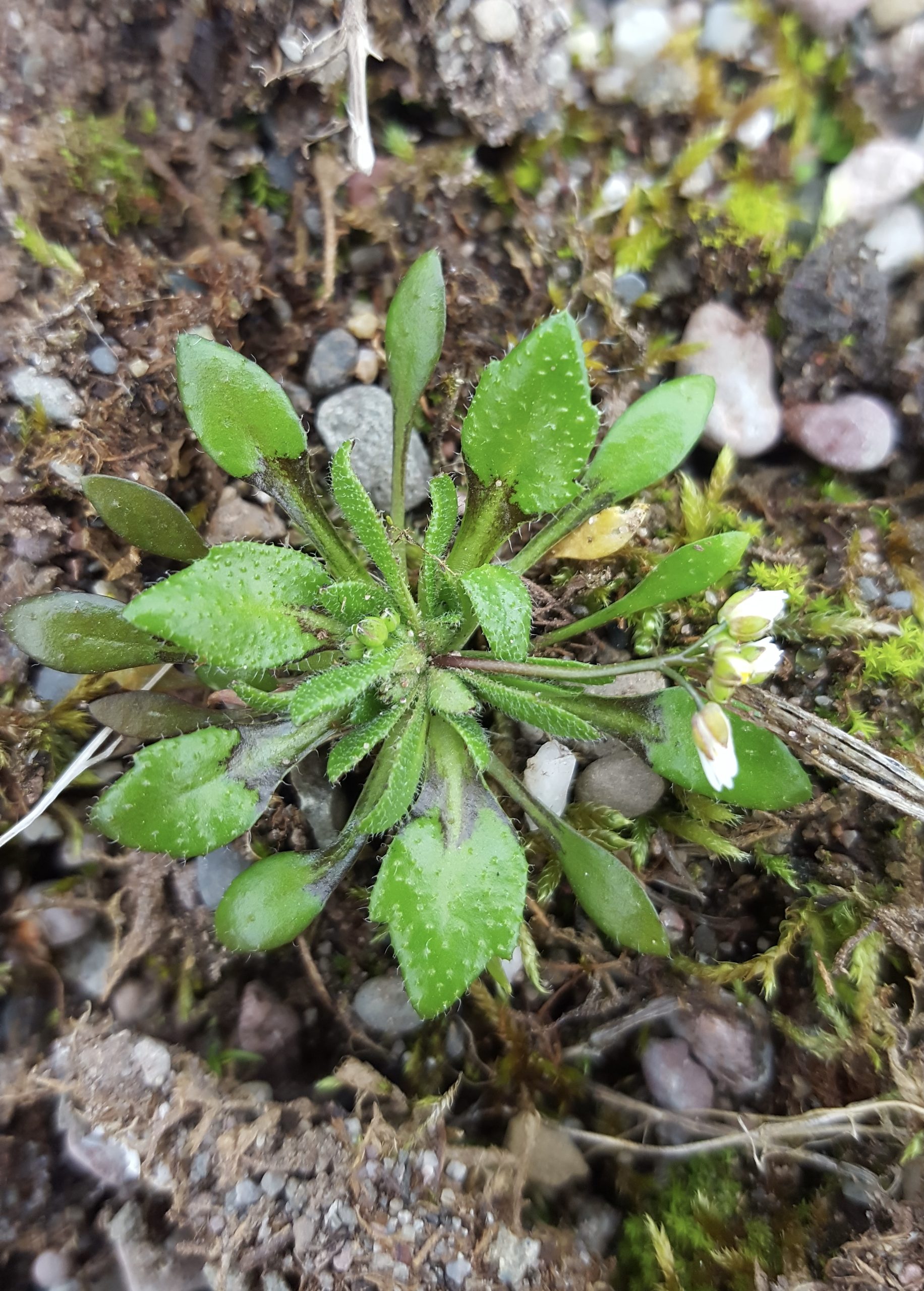
Hairy Whitlowgrass Erophila majuscula is the most distinctive of the three taxa with densely hairy greyish leaves and has been confirmed on the Malverns, where it is rare. If found, it should probably be carefully photographed rather than collected. Its diploid chromosome count is 14. A cluster of records in the White Peak suggest it may be the taxon most associated with ancient (ie non-anthropogenic) habitat, that of soil pockets on rock very prone to parching. It is possible that its greater hairiness may confer a selective advantage in such places through moisture retention and light reflection. If this is the case we should be looking for it also on the Silurian rocks of NW Herefordshire where a range of other winter-annuals are well-represented.
The great majority of plants will now be found in anthropogenic habitat however. In Hereford it is not hard to find populations in the thousands or even tens of thousands of plants on the margins of car parks and other neglected corners of landscaped surface. Vehicles, including street-sweeping machines, and high footfall seem to disperse seeds very readily. These surfaces may well be more moisture retentive than the wild habitat in which the plant evolved, as water puddles for longer on flat concrete surfaces which also often develop moisture-retentive cushion of bryophytes, esp Didymodon spp. Large populations may be especially productive to sample, being more longstanding and as such having had more opportunity to develop polyploids. Selfing is common in the whole suite of spring annuals with small white flowers, not just Erophila. One figure found online for the frequency of autopolyploidy events is once in 100,000 – perhaps not an uncommon number of individuals in a large urban populations of Erophila verna in a single season. On a visit to Hereford of 3.2.25, three out of four sites sampled had both Common Whitlowgrass Erophila verna ss. and Glabrous Whitlowgrass Erophila glabrescens, a polyploid derivative.
Glabrous Whitlowgrass, Erophila glabrescens Jord.
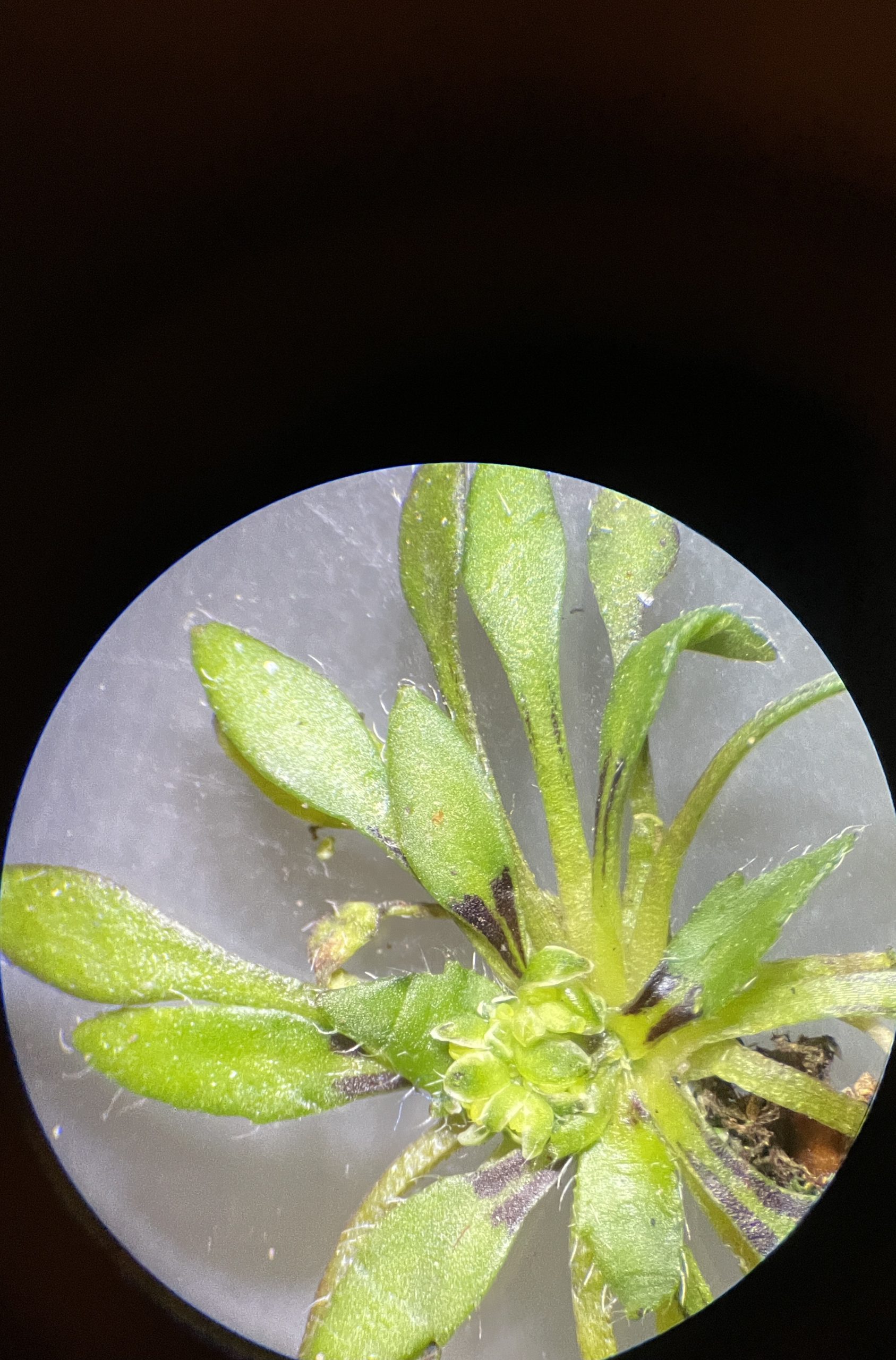

Both the above localities contained mixed populations. The key thing to note is that even the youngest leaves lack hairs on their surfaces; by zooming you may see one or two, and almost all of any you do see will be simple hairs. The leaf margins on the other hand are set with long, simple hairs (cilia) at fairly regular intervals, though, as we are told, these wear off with time leaving the outermost ones often completely bald. The East St specimen also shows the relative glossiness of the leaf surface. Although not visible in the photos, there are no signs of hairs at all on the short length of unexpanded flower scape.
Common Whitlowgrass, Erophila verna (L.) DC.
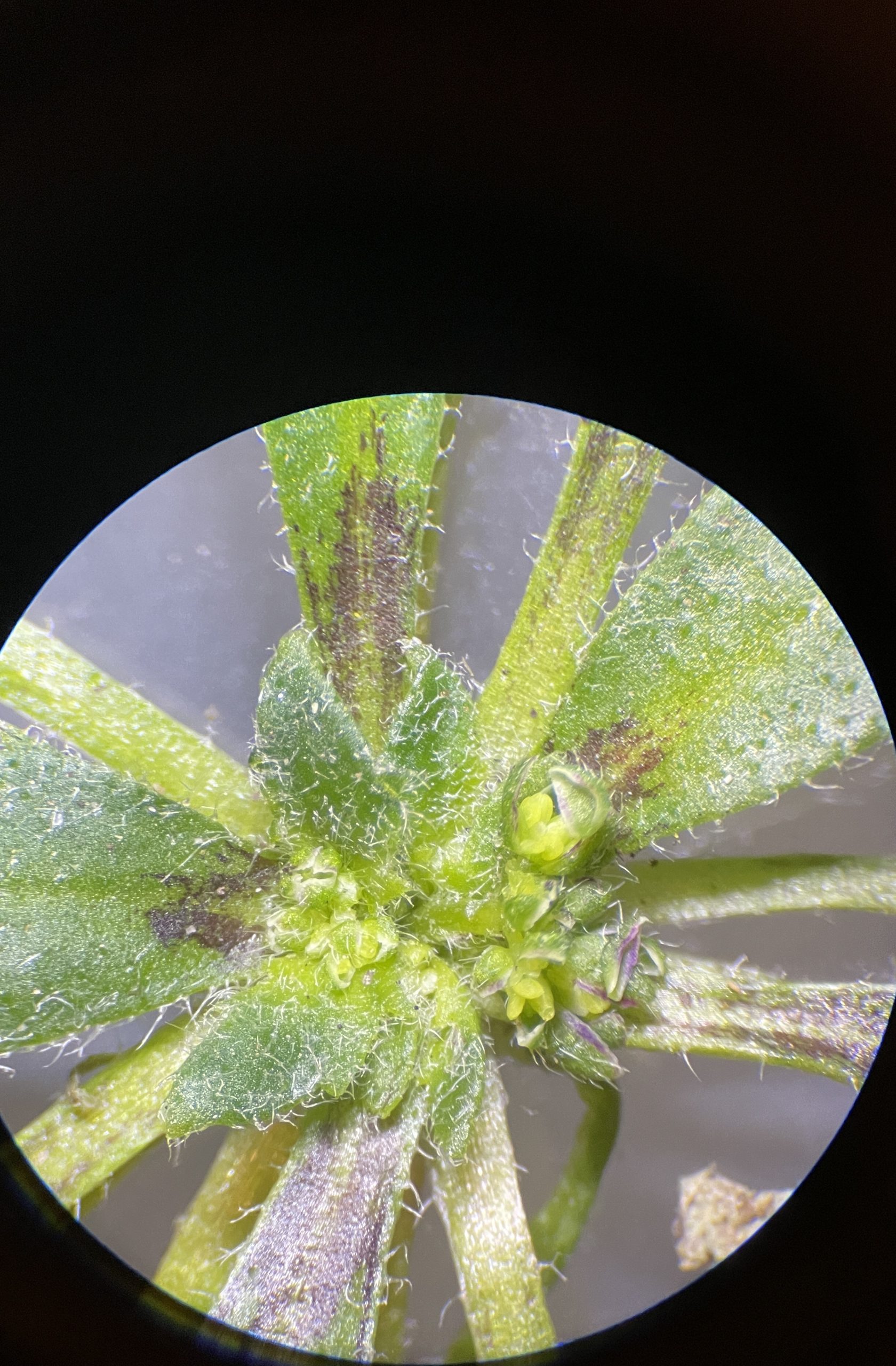
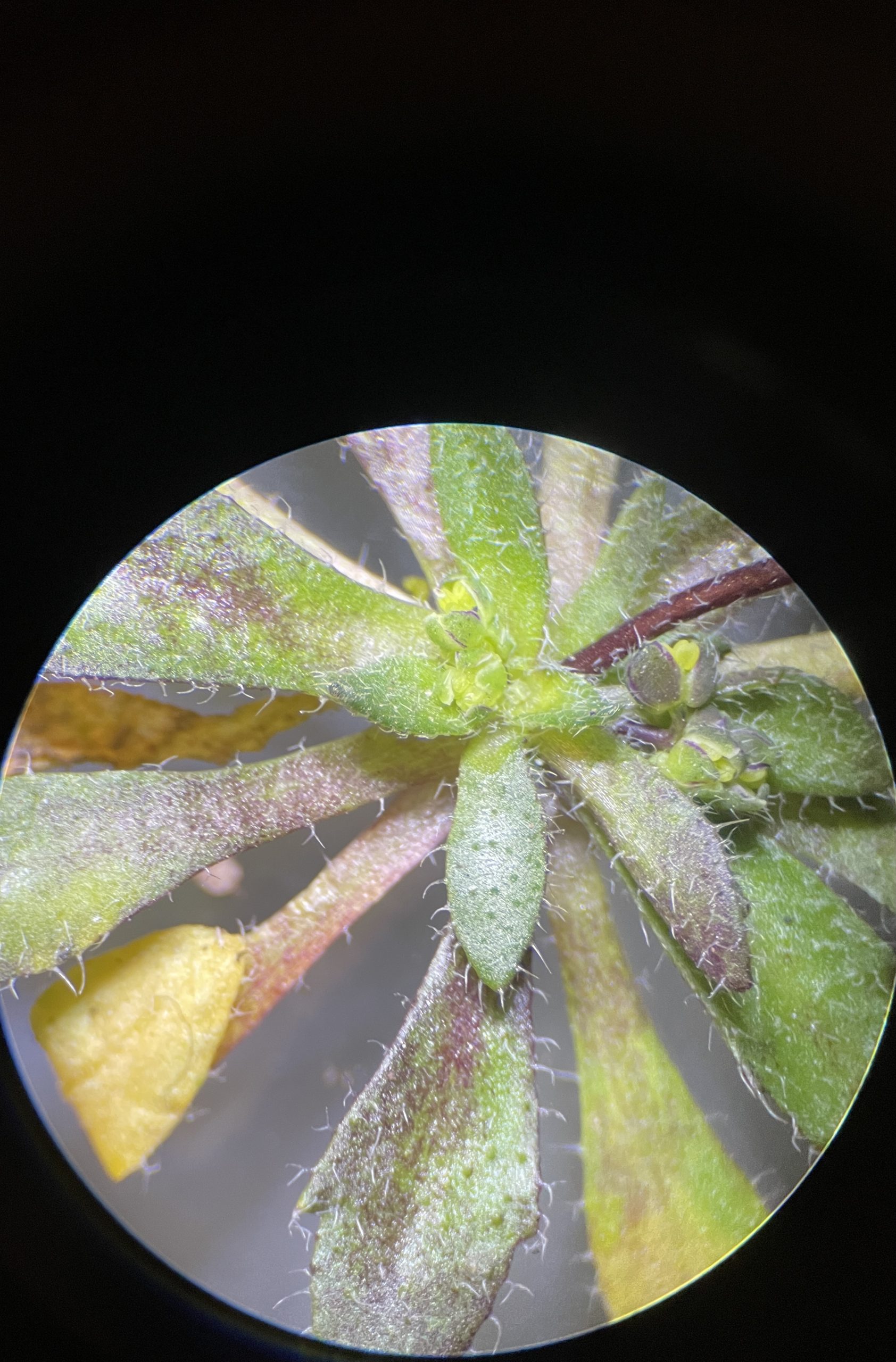
Once again, focus on the youngest leaves. No problem here finding hairs on the surfaces, and the majority are bifid; both specimens show how the swollen hair-base catches the light and gives a goose-pimple effect, such as you get in Selfheal. Both these images also show the scape on the point of elongation, and you can already see that bifid hairs are moderately frequent on the lower part.
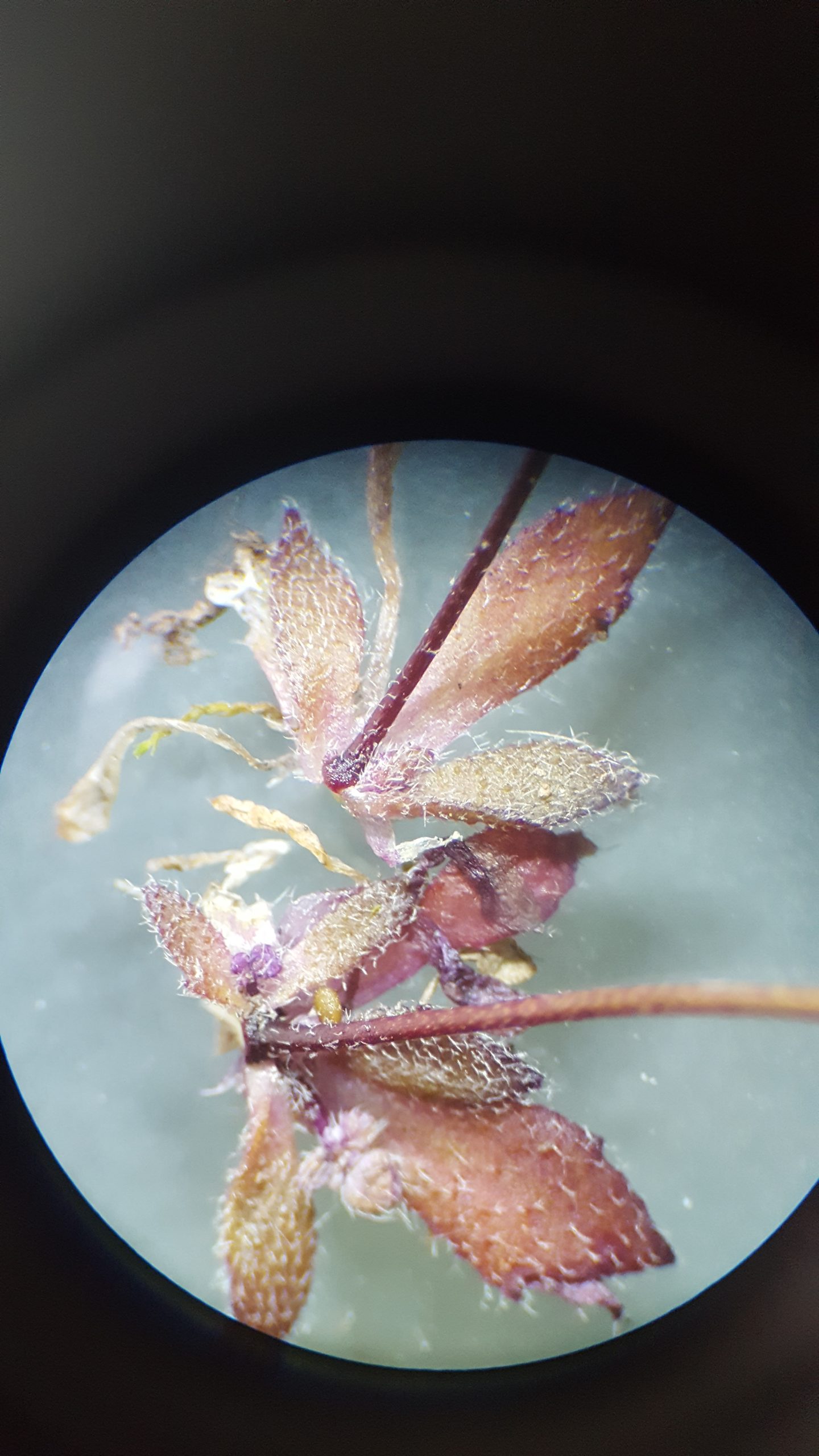
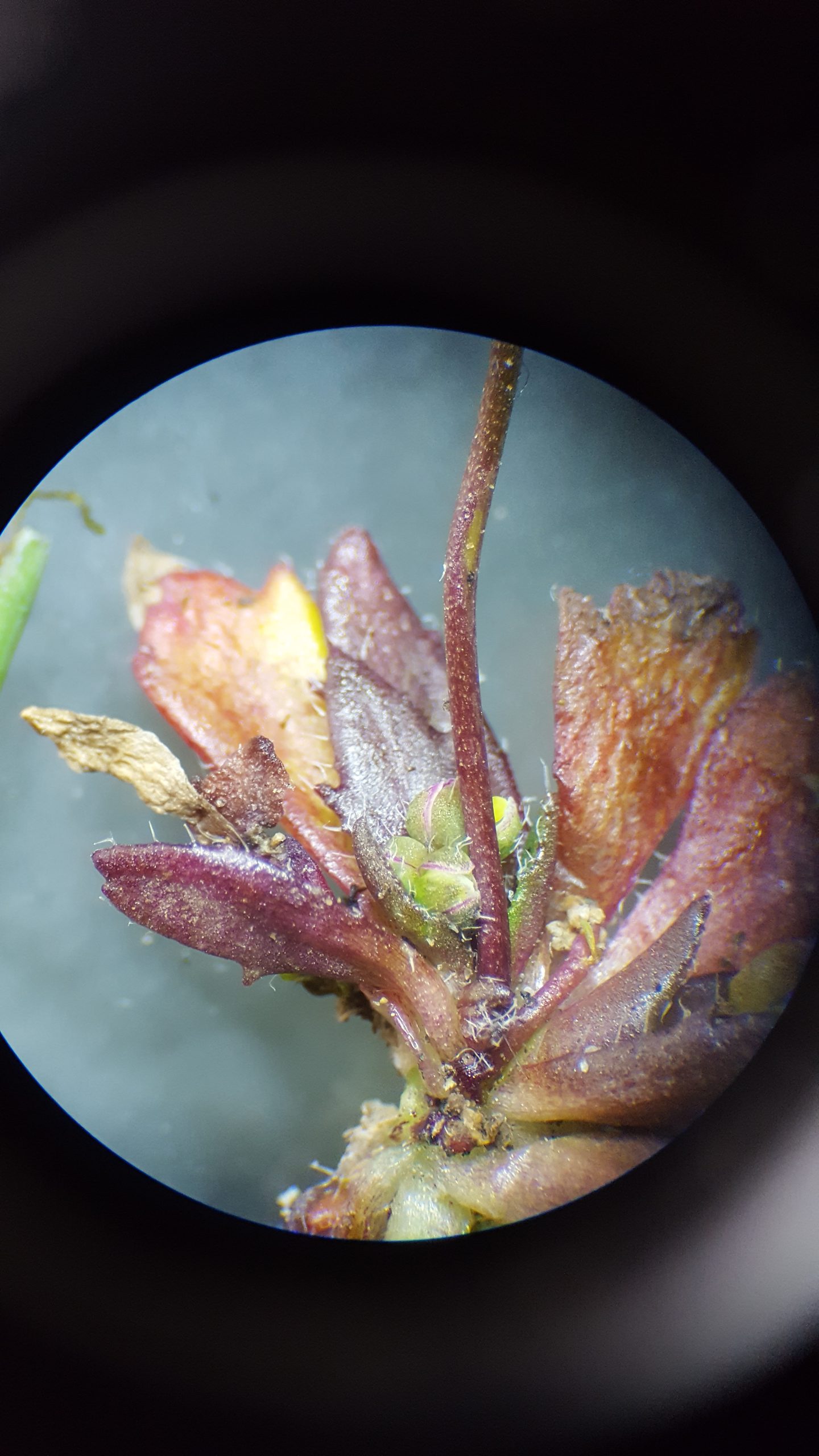
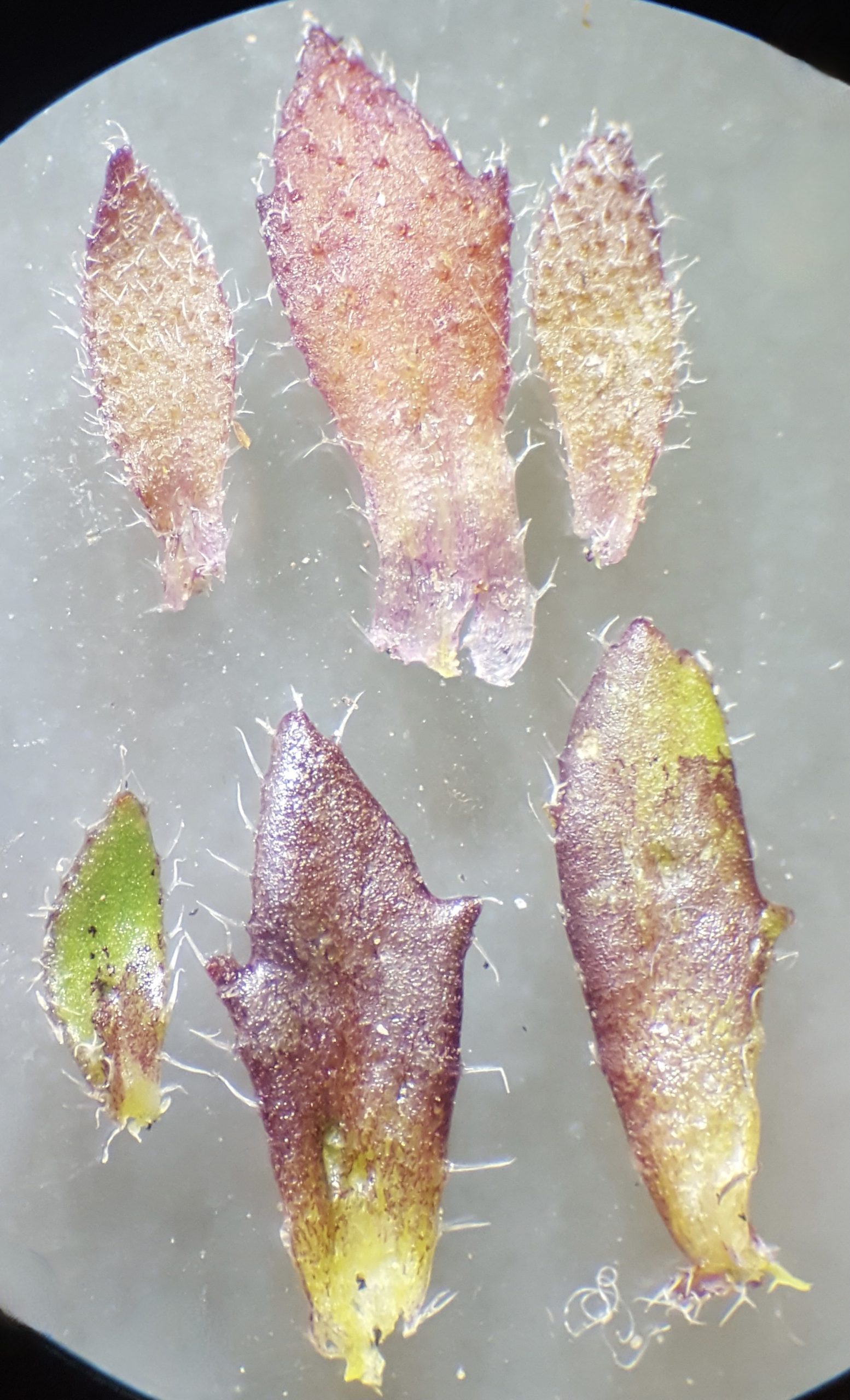
These two ‘species’ have less cytological integrity than meets the eye. In order to make a workable species concept Common Whitlowgrass Erophila verna ss is the name given to plants with low levels of polyploidy (2n = 30, 32, 34, 36, 40, 42 (hexaploid) and 44 of those investigated). Glabrous Whitlowgrass Erophila glabrescens is the name given to plants with high levels of ploidy (2n = 48, 52, 54, 56). Notice how most of these cytotypes are not exact multiples of the diploid (14). They are aneuploids: incomplete multiples stemming from imperfect acts of meiosis. If these higher levels of ploidy produce in general more glabrous plants, one might ask whether a 2n = 44 plant is really going to look all that much hairier than a 2n = 48 plant.
Lastly, a word on other characters. I haven’t yet found the degree of petal division to be helpful, but the difference between no more than half and from half to three-quarters is scant. The petal is clawed to boot, so you must carefully detach it if you are to be in with any chance to make this assessment. You can’t do it by eye, simply looking at the flower in situ.
Leave a Reply